Monday, August 23, 2010

At the Judenplatz

For my 22nd birthday, one of my presents was another fantastic tour with Dr. O, this time in the Leopold Museum, which houses a lot of art from around the turn of the 20th century. Much Klimt, Schiele, and other Jugenstil-style art. This particular day was a special day to be at the Leopold Museum as Schiele's apparently famous "Portrait of Wally" was back in Vienna for the first time in ages. I saw a newspaper headline that proclaimed it to be "Austria's Mona Lisa," but Dr. O wasn't too sure about the authenticity of that claim.

The walking tour of the afternoon saw us at the Judenplatz, where my attention was caught immediately by the large memorial to the Holocaust in the center of it. It is The Nameless Library - a large library that one can never penetrate as the spines are all turned inwards. They represent the stories of the countless Jews that can never be known now.


It is undoubtedly very stark and meant to provoke. Yet I find it a bit ironic that there is a plaque from 1500 not too far away commemorating a pogrom against the Jews that happened in this very square. How can both of these monuments to similar tragedies - but with different attitudes - coexist? And why is the "pogrom plaque" still up there in this day and age? I suppose it is alright to have other plaques around the square that recognize atrocities committed against the Jews in Vienna but still...something just doesn't seem right.

The German word of the day is "wegen," meaning "because of."

Sunday, August 22, 2010

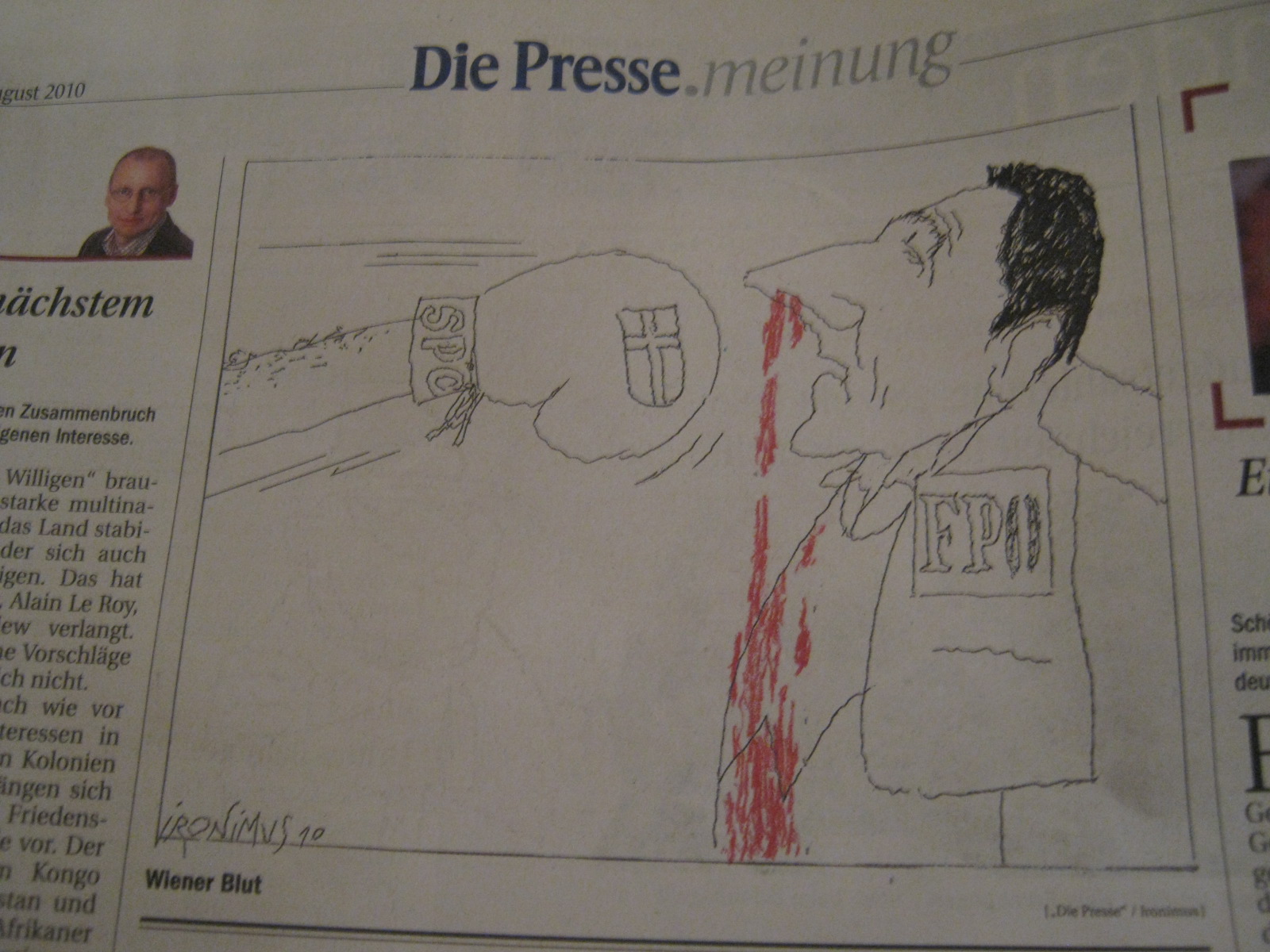
Wiener Blut

Instead of describing my day (which was mostly uninteresting) I'm going to write down some thoughts about present-day occurrences.

Last week during several days' lecture, there has been mention of certain posters put out by the Freedom Party of Austria (FPÖ), the country's dominant far-right political party. These posters have been the work of the man whose face is on them, Heinz-Christian Strache, chairman of the FPÖ. All of them have party slogans boldly displayed; one of the most prominent slogans displayed reads as follows: "Mehr Mut für unser Wiener Blut - Zu viel Fremdes tut niemandem gut." This slogan almost rhymes in English as it does in German: "More courage for our Viennese Blood – Too many foreigners does no one good."

It's easy to tell what it is and what Strache is implying. This is an anti-immigration slogan. What makes is particularly controversial is it's reference to "Wiener Blut," a waltz by Johann Strauss II that has absolutely no political connoatations. Yet Strache is drawing up this Austrian hallmark from history to argue against non-Austrian peoples from entering the country and city. He has even made other slogans in the same vein: "Pummerin, not muezzin," "Vienna must not become Istanbul," and so on.

I'm glad to hear from Professor Stuart that this guy is considered kind of a wack-job in Vienna, and that there has been a big backlash against him and his posters. (I've even seen several of his posters with obviously deliberate tears across them.) And from hearing more about him, I have to agree. Supposedly, he's been trying to reach out to ethnic Serbs in Vienna, just how can turn them against the Turks. I see something wrong here: he's against non-Viennese blood, yet he's trying to seek support from such people? It's apparent that he's not really against foreigners; he's against foreign religion - Islam.

And this is something that seems to be happening all over the western world - even back home. Islamophobia is a big issue here, and while I do not know what will happen regarding it in the future, I am fascinated by it's relationship to Austria and Austrian history. For Austria has, upon examination, been traditionally wary of foreigners, to put it mildly. It's recent past forces it to re-examine itself, something it is still trying to do today. And how does the country do that in light of these new social and cultural challenges?

We shall see in October, when Vienna holds city-wide elections. Until then...HC Strache is a wack-job. And I think this political cartoon that I found in a newspaper at Cafe Central agrees with me.


The German word of the day is "krank," meaning "ill."

Saturday, August 21, 2010

Bicycling Along the Danube

Honestly, I think today has been my favorite day in Austria so far.

It began with Prof. Stuart, Sara, Stephanie, Harrison (an alum from last year's Vienna program) and myself renting bicycles at Pedal Power, then running through the U-bahn lines to catch a train to Krems, a little town up some distance on the Danube River, towards the west.

And from there, the plan was just to simply bike...

And bike we did along the Danube, passing through many small towns, innumerable vineyards, several medieval ruins on the hilltops...among these ruins, the most notable one was the Castle Dürnstein, in the town of the same name. This was where Leopold V held Richard I of England for ransom; that same ransom money was later used to fortify the defenses of Vienna. The town of Dürnstein itself was a fairly pretty sight too, and the plums that a local encouraged me to pick off a tree by the river were undeniably tasty.


There were many more bicyclists along this path than just us. I learned, in fact, that this particular path runs from Passau on the German border all the way to Budapest, and people can bike the entire path in a few days while spending nights in little towns like the ones we were passing through! This sounds like something I'd like to try someday, maybe once I'm a bit better in German.


It was absolutely necessary to stop for food a few times, and we tried to find real heurigen to eat at. We did find one that was truly authentic (I believe it was in the town of Spitz). The wine and blutwurst were great as was the atmosphere; it felt like a really cozy, local place. This was the kind of place that Rick Steves would stop at if he was bicycling along the Danube. He might also have done what I did shortly thereafter: I purchased a jar of apricot preserves and a bottle of apricot schnapps from a roadside stand, both homemade. I had heard that apricot products were big in the Danube valley back at the orientation meeting last February, and these stands were something I was looking forward to. And I can assure that the schnapps is quite the stuff!!


All the little things we found along the way were wonderful. The heurigen, the schnapps, the ruins on the hillsides...Professor Stuart was especially fond of the altar made of human bones and skulls in one town just short of Spitz. I won't put up a picture of that, as I'm not into the macabre as much as she is! Instead, here's the beautiful view I caught from the top of the church's tower:


Eventually, evening came around, and with it our time to head back to Vienna. This proved remarkably simple: our single train ticket (good for the whole group) allowed us to hop on at any station we needed to, so we simply got on a train at Melk and spent the rest of the way back chatting animatedly with each other and with a few Austrians who learned we were from California ("Oh, you know Arnold Schwarzenegger?"). I cannot say just how glad I am that instead of trying to visit a whole other city, I took the time to see a different side of this country, and it was for sure one of my favorite days here.

The German word of the day is "vielleicht," meaning "maybe."

Friday, August 20, 2010

A Visit with the Austrian Healthcare System

Today it was decided that my ankle has been bothering me long enough, so a visit to the hospital was in order. Before I write any more, let me give a shout-out to Josh Lyons, our excellent program coordinator who accompanied me every step of this slightly confusing way.

We took the U6 to Michaelbeuren-AKH. Josh has been this way several times already with other sick students so he thankfully knew where to go. I sure wouldn't have been able to navigate the hospital! Especially one with two different emergency rooms; we were directed to the second one after visiting the first, which Josh has visited every other time he's come to this hospital.

We went to the front desk at the second emergency room, where we explained (in German and English; thankfully all doctors here spoke some of the latter) how my ankle had swollen and how we suspected there might be a fracture. The doctor examined my California driver's license (he happily exclaimed at the state I was from) and gave me a very simple sheet to fill out. After waiting about 75 minutes, I was called to be examined.

It was decided that I would need a few x-rays, so after waiting a bit more, I got them taken, whereafter it was found that nothing was fractured, everything was fine, it was just recommended that I put some anti-swelling lotion on my ankle. Needless to say, I feel really good now that I know my leg is alright.

So now I must ask, what do I think of this whole Austrian healthcare experience? Admittedly, I only saw a tiny part of it, but I guess it seemed like a well-run system to me. I write this while thinking about the time that I really fractured my leg in Davis. That day, I had to fill out so much paperwork: in the ambulance, in the guerney at the hospital, leaving the hospital after receiving crutches...and here in Vienna I only had to turn in one simple sheet! Maybe I'd have to write more if something was really wrong with me, but from what I experienced, I was pleased with the amount of paper bureaucracy I had to penetrate!

The (quite appropriate) German word of the day is "gesund," meaning "healthy."

Thursday, August 19, 2010

The Historisches Museum der Stadt Wien

It seems more and more like the Biedermier period in Austria is analagous to the United States of the 1950s. Austrian middle-class families sought out a wholesome way of living under the watchful eye of Clemens von Metternich, who appears to me as a kind of Joseph McCarthy figure. At least, this is the analogy that has been explained to me in lecture. It certainly seems to make sense after seeing some Biedermeier paintings at the Historisches Museum der Stadt Wien. Many of them feature scenes that are very homely and familial. Some of them are pastoral and focus on the Austrian peasantry that must have had a certain degree of charm to the bourgeoisie audience for which the paintings were made. This museum also contains some Biedermeier era furniture, as seen here:


I am no great expert on furniture design, but I would say that they look rather "conservative." They are not meant to be overly ostentatious, I guess you could say. I could be wrong, but I think that this is the period in which Nicholas Parsons describes Viennese as "seeking happiness in a quiet corner." And making sure they don't form any suspicious groups in public, lest Metternich's police feel the need to question them!

Also at the Historisches Museum der Stadt Wien was a pretty interesting exhibit on Vienna's appearances in films and movies. I do not know very much about film history, but I did learn that up to the 1960s, Vienna's image in film was meant to tell of the "good old days," of a past remanufactured to promote tourism to Austria. Obviously, these images do not involve anything between 1938-1945. So it is then interesting how from the '60s onward more experimental films of the city were made which confronted Austria's uneasy past and skeptically questioned whether the Nazi's mark on the country's history had been overcome.

This museum turned out to be a very good visit. Afterwards, I decided that I should check out Schönbrunn Palace, since I hadn't seen it at all yet. Unfortunately, my left ankle was hurting a lot (possibly from something I did back in the Alps), and it was a bit difficult to walk through the magnificent gardens. Oh yes, they were definitely magnificent, and it wasn't the first time in which I tried to imagine myself as one of the old Hapsburgs! But eventually I decided I had to leave the beautiful geometricly-cut hedges and give my leg a rest back at the apartment. I think I may need to get it checked very soon.

The German word of the day is "möglich," meaning "possible."

Tuesday, August 17, 2010

"I speak for all mediocrities."

The title of this blog entry is what I said after trying to conduct the Wiener Philharmoniker. Well, the virtual one, anyways. It's something I wanted to try as soon as I found out about it and it's location at the Haus der Musik. I thought that being a guy who pretends to conduct orchestras on his iPod would mean that I would be alright with leading a virtual orchestra but they all played "Eine Kleine Nachtmusik" much slower than I was commanding. Oh well. I blame the electronic baton.

Certainly there were other great things to see at the Haus der Musik. The first floor, for instance, is devoted to the real Wiener Philharmoniker, and a small theatre there plays the latest of their famed New Year's Day concerts every hour. That was a good, relaxing forty minutes spent listening to some the best in Austrian classical music. Strauss's "Blue Danube" waltz was of course performed, as was his father's "Radetzky March" immediately afterward. Those two pieces are always played at every New Year's concert.

The second floor wasn't so much about music as it was about sound itself. It was bit strange and reminded me of the Discovery Science Center back in Santa Ana, California. The first room you walk in to on that floor is supposed to replicate the sound you hear as a baby in the womb! Interesting stuff, I guess, but the third floor was where the Haus der Musik really got good.

That floor focused entirely on Austrian composers, with most of them getting a single large room devoted to themselves. Haydn, Mozart, Beethoven, Schubert, Strauss the younger, and Mahler all had such rooms, and then there was another room devoted to the likes of Schoenberg and Webern. This floor was very educational and I tried to take my time reading everything that was on display here. One thing that I learned in the Haydn room was that the Viennese classical works were innovative since they were the first works that were composed with the average listener in mind and not a learned expert. This era was also one of the first times that a composer's individual personality could prevent his music from being tampered with at all. I found this to be really interesting, and I really ought to listen to more Haydn and compare his work to earlier composers, maybe Bach. I'd like to be able to recognize someone's personality in a piece of music I'm listening to. I'm fairly good at figuring out when something was composed, just not by who. Oh, and I also found out that Gustav Mahler had therapy sessions with Sigmund Freud! He's another composer I wish I knew more about. Ah, there's just too much to listen to in this city!

At the end of the pathway on this floor was the virtual conducting session that I described previously. If there wasn't a line I would have tried it again and again and again. But at least I can say I did it, and the virtual players didn't stop to grumpily point out the flaws in my technique, but nevertheless...I was but a mediocrity among geniuses in this place. (And I am indeed deliberately referencing Amadeus here.)

The German word of the day is "schmecken," meaning "to taste."

Monday, August 16, 2010

Returning to Vienna

There was just enough time for one thing to do in Prague this morning before heading off back to Vienna, and that was visiting the Jerusalem Synagogue in the city's Jewish quarter.

It was a synagogue of amazing architecture. It was built in 1906, and as an informational brochure told us, features an Art Nouveau stylization of Moorish architectural style. Inside, it certainly looks like this building could be in Spain or north Africa or somewhere other than Prague. The arches are explicitly reminiscent of Islamic arches. There were other plans drawn up for the design of this synagogue which incorporated both neo-Romanesque style and neo-Gothic style. Both of those styles would have also been very interseting to see incorporated into a Jewish house of worship, and I wonder why such historicist styles were considered for this particular synagogue. It is very fortunate that this place escaped the damage of World War II entirely.

I would have liked to spend more time around the Jewish quarter, but it was time eventually to get back on the train towards Vienna. However, I was not unhappy about this. Prague was a nice enough city but I just couldn't connect to it and enjoy it like I have with Vienna. I think several factors result in this:

-I had less than two total days to explore Prague.
-I had not read up on Prague as much as I had Vienna.
-The city just seemed a little more crowded and claustrophobic to me, and
-I just didn't really like the amount of English there, even though its the only language I speak fluently.

I felt like I was being catered to in Prague. There was no challenge of having to reach out into the local culture to become a competent traveler in the city. This is what Vienna has made me do, and I have appreciated it all the way. I want to get absorbed in another language and culture, and I want to try and get to know how the city works through my own experiences. I guess Prague just really wants visitors to come and spend money on it.

Maybe someday I will go back to Prague when I know a little more about it, but until then...I think I'll keep a lot of my traveling with Austria.

The German word of the day is "zelten," meaning "to camp."